
By Evan Draga and Shawn Boehmer
Last year, two Cornell seniors started Civoren, a startup that aims to democratize U.S. elections. The founders, Adam Rose and Sam Alston, recently left their jobs in finance to pursue the vision full-time. In an interview with Shawn Boehmer of The Harvard Crimson, Adam described a vision that goes far beyond campaign websites or easier election browsing. He wants to build the central platform for American elections: the place voters go to understand who is running and engage with campaigns, and the place candidates go to be discovered, define themselves, and run their campaigns.
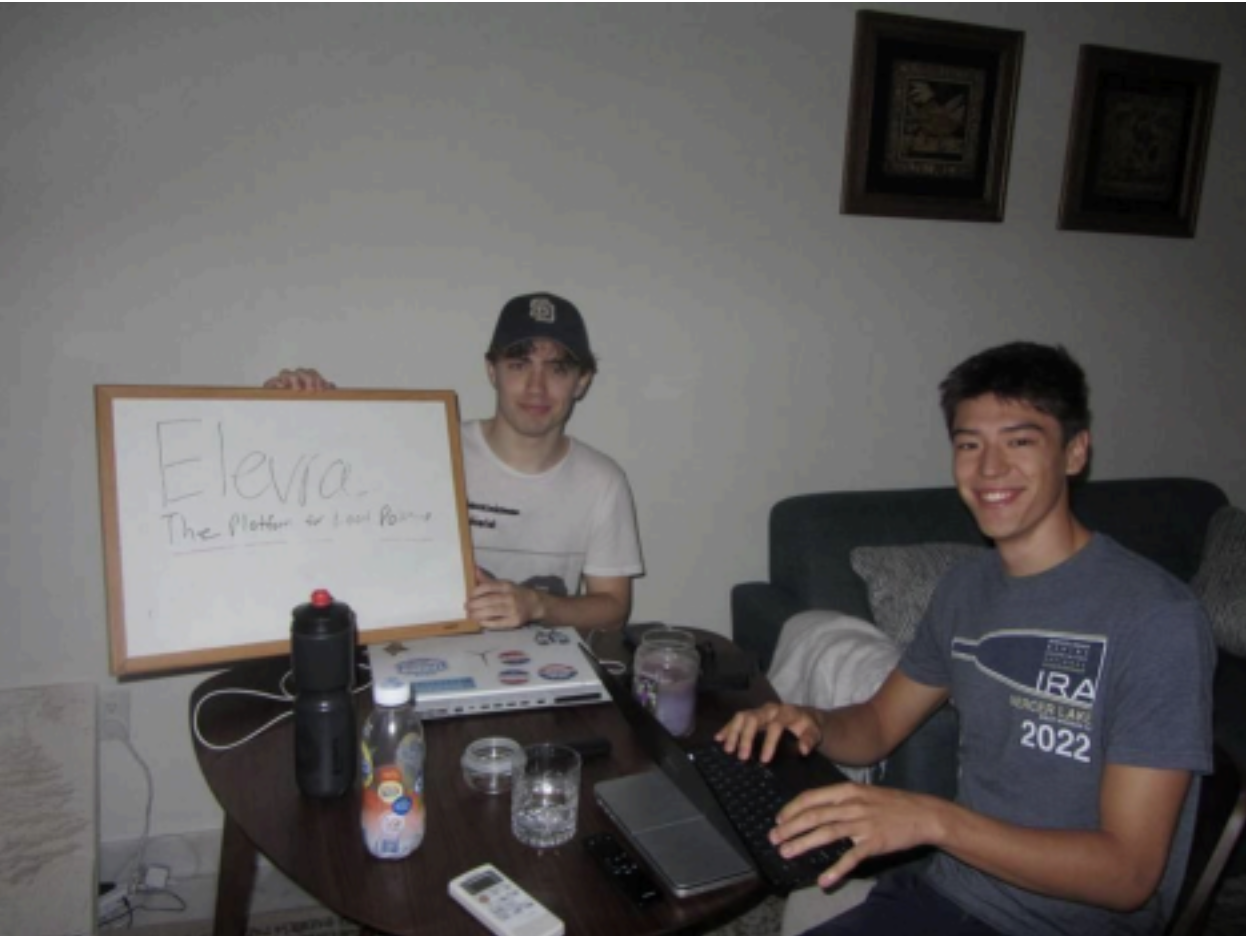
Rose and Alston using the original company name, Elevra, in the summer of 2025 after graduation.
That ambition is matched by the team building Civoren. Rose graduated with Honors from Cornell’s School of Industrial and Labor Relations, with experience in local government, Senator Elissa Slotkin’s 2022 campaign, and as ILR Class Representative for 2025. He is building the company alongside co-founder Sam Alston, a Cornell Computer Science graduate and former varsity lightweight rower who competed at the Henley Royal Regatta. Before joining Civoren full-time, Alston worked as a software engineer at a multi-strategy hedge fund, bringing technical depth to a company trying to solve a hard infrastructural problem at scale. Advisor Zach Leighton contributes more than a decade of experience across politics and government. Leighton served as Senior Advisor to the U.S. Ambassador to Germany at the State Department and Chief of Staff for the Office of the Staff Secretary at the White House. He also worked on three presidential campaigns.
Civoren began with a moment of curiosity at Cornell. Rose looked up another student and discovered, almost by accident, that the student had run for and won a local seat in Ithaca. What struck him was how little existed around the race. There was no real place to understand the campaign, the competition, or how to get involved. That discovery sharpened into a larger realization: elections remain far less technologically optimized than they should be.
Rose’s thesis is simple: “We don’t have a modern election platform.” This gap undermines democracy in the U.S., making for too many uncontested races and contested races where only incumbents really have a fair chance. Civoren is Rose’s answer to that gap. The company is built around the idea that elections should be much easier to navigate than they are today, and that one platform should be able to serve both the public and the campaigns themselves.
On one side, Civoren gives citizens, voters, supporters, donors, and volunteers a clear way to discover races, understand candidates, and take action. On the other side, it gives candidates a stronger presence and, over time, tools that make campaigning easier to execute. The same platform that helps people discover a campaign, Rose believes, should also help that campaign grow.
That is where Alston’s work becomes central. Civoren is trying to organize a fragmented universe of election information and make it usable for both the public and campaigns. Doing that at scale requires serious technical work: retrieval systems, information architecture, and software capable of structuring complex election data in a way that feels simple and intuitive to the user. What sounds straightforward on the surface is, underneath, a hard engineering problem. Alston is building the systems that make that possible.
For Rose, this is not just a product gap. It is a democratic one. If candidates remain difficult to find and difficult to engage with, participation suffers. Civoren’s bet is that stronger discoverability can do more than inform voters; it can help supporters get involved, encourage more people to run, and make elections feel more open and competitive. There is plenty of public encouragement around voting, but little to none about running for office. The company’s ambition is not simply to organize information, but to make participation easier on both sides of the electoral process.
That helps explain Rose’s posture as a founder. He does not come across as someone trying to make a minor improvement to an existing category. He sounds like someone building around a glaring gap in American public life. He is candid that politics is messy and fragmented, which is precisely why the work matters. As he put it near the end of the interview, “I’m motivated by the fact that I know the country really needs this.”
There is a real need to build lasting infrastructure around American elections. The idea is no longer theoretical: more than 350 candidates have already signed up for Civoren, and the platform has generated over 180,000 page views. Sign-ups for Civoren are seen all the way from school board and county council to gubernatorial races. Some campaigns are already paying for enhanced tools and visibility designed to help turn attention into support. With Alston building the technical foundation and Leighton adding political understanding, Rose is building with the conviction that this category is still wide open to be defined. Civoren is aiming to become essential to how elections are understood, supported, and run.