
By Anoosha Mallakanti
For international students graduating into a competitive job market, understanding the pathway from student to working professional requires careful planning. For them, “dreaming big" often means fighting the clock: 60 days to secure a job, 12 months to prove your value, and one lottery that can decide your future. This article aims to explore the current situation of F-1 students and the economic impact of changes surrounding enrollment and employment.
Understanding the F-1 to Employment Pipeline
Most international students in the U.S. begin their journey on an F-1 visa, which permits them to study at accredited universities. The transition from student to working professional follows a structured pathway that's important for students to understand early in their academic careers.
After graduation, F-1 students have a 60-day grace period to either leave the country, continue their studies, or apply for a change in visa status to remain legally in the U.S. The most common bridge between student life and employment is what’s known as practical training, temporary work authorization that lets students gain experience directly related to their major.
Under the U.S. Citizenship and Immigration Services framework (USCIS), there are two main types of practical training:
Curricular Practical Training (CPT) allows students to take on internships or co-ops while still enrolled in school. This provides valuable early work experience and helps students build professional networks before graduation.
Optional Practical Training (OPT) grants up to 12 months of work authorization after graduation. Students in STEM fields can apply for a 24-month STEM OPT extension, effectively giving them up to three years to work in the U.S. before needing another visa status.
At the end of the OPT period, many students transition to the H-1B visa, which allows employers to sponsor them for specialized professional roles.
A Stir in the Job Market
The employment landscape has shifted significantly in recent years. To better understand this, let's take a look at the “scariest chart in the world.”
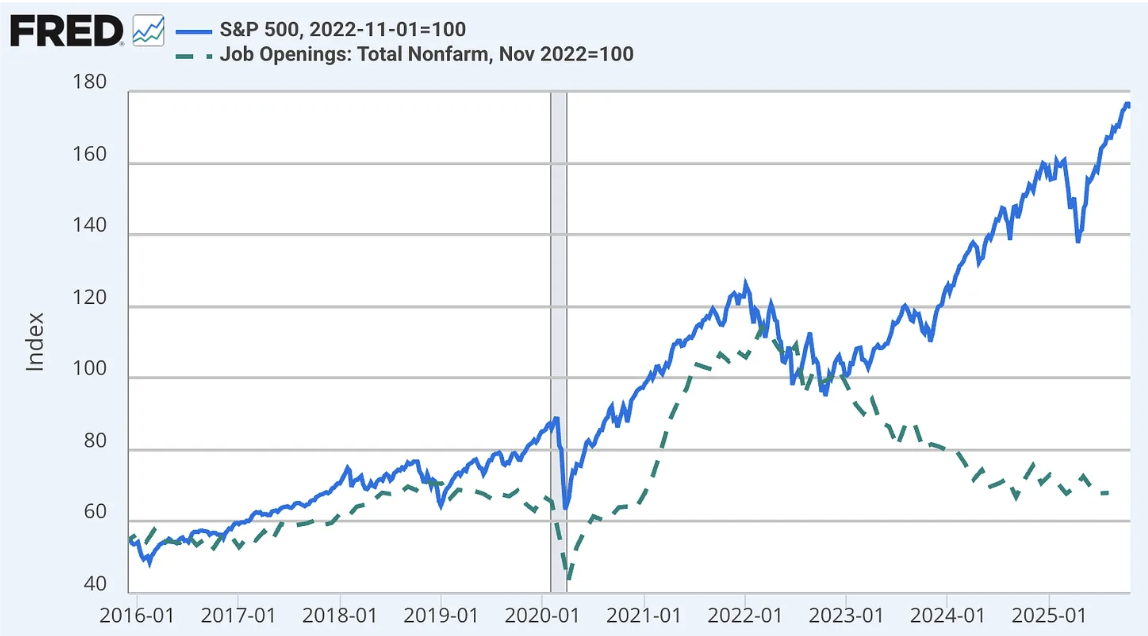
Amidst COVID's fear wave, OpenAI launched ChatGPT. Now, five years later, we are seeing the effects of this magical platform that can answer almost any question you may have. Since GPT's launch in 2020, job openings have dropped about 30% while the S&P 500 shot up about 74%. So, is AI truly out to get all our jobs?
While a report by journalist Derek Thompson claims that the truth is more complex than it seems, the reality for graduates is clear: companies are operating more efficiently with leaner workforces, technological advances are reshaping hiring needs, and competition for available positions has intensified across all candidate pools.
The technology sector, which has historically been a major employer of international talent, has seen significant workforce adjustments. In the past eleven months alone, major tech companies have reduced their workforces by approximately 112,000 positions. This affects all graduating students, regardless of visa status, as competition for remaining openings increases.
A Deeper Look at the Numbers
Research has shown that students who apply to twice as many positions actually receive 30% fewer offers. This gap reflects both the competitive market and the additional complexities of visa sponsorship. Many companies, particularly smaller firms, opt not to navigate the H-1B sponsorship process due to cost, uncertainty, or administrative complexity. This is not a policy decision – it is often a practical and necessary business calculation given resources and timing.
On October 6, 2025, The New York Times published an article showing nearly a 20% drop in incoming international students in the fall, the steepest decline since the pandemic.
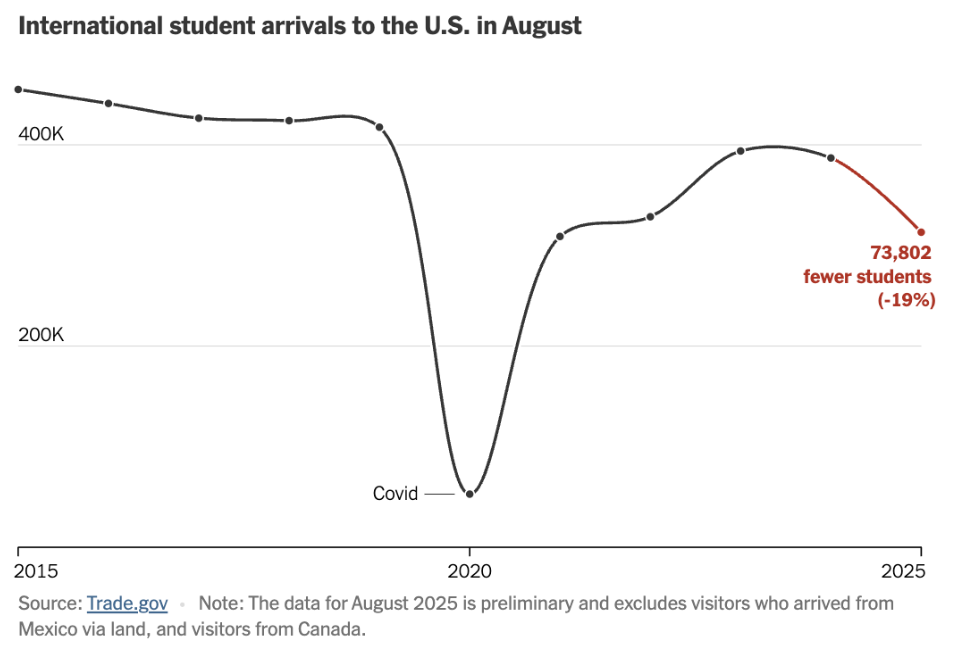
This isn't just a number on a spreadsheet. It represents tens of thousands of students who chose to pursue their education elsewhere. That is 73,802 top brains choosing other platforms to take their ability to innovate and contribute to the American economy. The implications extend far beyond university admissions offices as this trend has measurable economic consequences that ripple through multiple sectors of the American economy.
According to NAFSA's Fall 2025 International Student Enrollment Snapshot and Economic Impact report, released in November 2025 and conducted in partnership with JB International, the decline translates into “over $1.1 billion in lost revenue and nearly 23,000 fewer jobs.”
Let’s break down these statistics. How do international students contribute to the U.S. economy and what's driving the current decline? We must first note that the enrollment decline isn't uniform across student categories and the economic impact stems from several factors:
Graduate enrollment fell 12% and non-degree students declined 16%, both groups that "typically contribute more through tuition, living costs, and accompanying dependents.”
The enrollment mix has shifted, with a 14% increase in students on Optional Practical Training (OPT), which "reduced the amount of campus-based spending (such as tuition, housing, dining)" since OPT students have already completed their degrees.
The $1.1 billion loss for Fall 2025 represents the immediate impact from fewer new students enrolling. International students, particularly at the undergraduate level, often pay full tuition without financial aid. At public universities, they typically pay out-of-state rates that can be two to three times higher than in-state tuition. This revenue doesn't just fund educational programs – it supports faculty salaries, campus operations, research facilities, and employs hundreds of administrative and support staff.
Beyond tuition, international students spend money in their communities. They rent apartments, buy groceries, eat at restaurants, use transportation, purchase textbooks and supplies, and engage in entertainment and travel. These living expenses that account for a significant portion of the annual contribution per student, directly supports local businesses and creates a multiplier effect as that money circulates through the community.
According to NAFSA Executive Director Fanta Aw, "For every three international students, one U.S. job is created and supported.” The 23,000 jobs figure represents positions that become at risk when enrollment declines. These aren't abstract positions, they're real jobs across multiple sectors:
Higher education: Academic advisors, admissions officers, international student services staff, English language program instructors, and housing coordinators
Hospitality and food service: Restaurant workers, hotel staff for visiting families, catering services for campus events
Retail: Bookstore employees, electronics retailers, clothing stores near campus
Real estate and property management: Apartment leasing agents, maintenance workers, property managers
Transportation: Local transit workers, rideshare drivers, airport shuttle services
Healthcare: Student health center staff, insurance coordinators
Technology and telecommunications: Phone plan retailers, internet service providers
These are predominantly jobs held by U.S. workers in communities where universities are located. When international student enrollment drops, the demand for these services decreases, and these positions become harder to sustain.
These numbers are for the Fall 2025 semester alone. As NAFSA's Executive Director Fanta Aw warned in the publicly issued statement, this represents the first decrease recorded since the COVID-19 pandemic, and the trend may continue. If the 17% enrollment decline persists or worsens, the cumulative impact over multiple years could be substantial. International students typically stay for multiple years (undergraduates for four years, graduate students for two to six years), meaning the full economic effect of this enrollment shift will compound as fewer students move through the pipeline.
The Value Proposition: Why International Talent Matters
Beyond immediate economic contributions, international students who remain in the U.S. represent a talent pipeline that has strengthened American competitiveness for decades.
According to the National Foundation for American Policy, immigrants have founded more than half of America's startup companies valued at $1 billion or more
A study by the Partnership for a New American Economy found that 40% of Fortune 500 companies were founded by immigrants or children of immigrants
Consider Sundar Pichai (Google), Satya Nadella (Microsoft), and countless others who began as international students. These individuals didn't just build successful careers for themselves, they created thousands of jobs, drove innovation, and strengthened America's position as a global technology leader.
The U.S. higher education system attracts top global talent. Students who complete degrees here gain technical skills, understand American business culture, and build professional networks. When these students transition into the U.S. workforce, they bring diverse perspectives and skills that enhance innovation and competitiveness.
Student Adaptation and Alternative Pathways
International students are nothing if not resourceful. When faced with challenges, they adapt.
A survey of F-1 visa holders at Cornell University provides insight into how students are responding to current market conditions. Of respondents, 85.7% reported actively pursuing alternative pathways:
Nearly a third (28.6%) are applying to master's or PhD programs in countries like Canada, the UK, and Australia, where post-study work authorization is comparatively more straightforward. On the other hand, an equal share are planning to start their own businesses. Some pursue this within the U.S. under International Entrepreneur Rule provisions or through alternative visa pathways, while others plan ventures in their home countries or third markets. Visa limitations are becoming catalysts for entrepreneurial thinking.
As the situation presents issues with physical presence in the country, some students are securing remote positions with international companies or U.S. companies willing to employ them from their home countries. And finally, around 14.3% of the respondents are planning to return home, often to growing economies where their U.S. education provides significant advantages.
These aren't stories of failure: they are examples of highly educated, motivated individuals finding ways forward.
Looking Forward
The intersection of education, immigration, and employment creates complex dynamics. While universities do not, and cannot, promise post-graduation employment, the students willing to uproot their life and move halfway across the world do so with an expectation that real career opportunities will exist on the other side.
The current environment requires international students to be more strategic than ever: securing internships early, building strong networks, targeting companies with track records of sponsorship, and maintaining backup plans. Many are succeeding despite challenges, finding employers who value their skills and are willing to navigate sponsorship processes.
From an economic perspective, the question is straightforward. The U.S. educates these students and benefits from their tuition and local spending. Does it make sense to then lose this talent to other countries?
There is no doubt that these students can succeed anywhere. The American higher education system remains world-class at attracting and training talent. The opportunity lies in ensuring the bridge from education to employment remains strong enough to retain the innovation and economic benefits that international students can provide.