
By Michael Chen
Six years ago, billionaire owner Joe Lacob led his NBA franchise, the Golden State Warriors, to complete a $1.5 billion expansion into their newly constructed Chase Center. This marked a business expansion strategy that moved the 40-year franchise from Oakland to the Bay Area in 2019. Initially launched in January of 2017, this expansion project partnered with investment bank J.P. Morgan Chase, who acquired the naming rights of the arena by agreeing to pay the Warriors $300 million over 20 years. Although Chase Center’s full seating capacity is only 18,064 — significantly less than Oracle Arena’s 19,200 — the expansion project proved to be immensely successful in the six years since completion.
Under the trio of Stephen Curry, Klay Thompson, and Kevin Durant, the Warriors ranked 7th among all 30 NBA franchises in terms of total home game attendance. This equated to 803,436 people throughout 41 home games played at Oracle Arena from 2015 to 2019. Such a record is staggering, as it meant that every single Warriors game hosted at the old arena had been 100% sold out. The first season played after migrating to the Chase Center, game attendance immediately declined to only 614,176. This exact drop was primarily due to COVID-19, but annual attendance only climbed up to 740,624 during later years. This represents a 7.8% decline in total seats sold. On paper, the Golden State Warriors seemed to have regressed.
Despite this, the Golden State Warriors recorded a tremendous 100% increase in overall revenue generated and steadily rising net income since the 2021-22 season. Moreover, the Golden State Warriors’ valuation has increased more than fivefold compared to a decade ago. Below is the team’s annual revenue over the 2015-19 seasons before moving to Chase Center:

We can compare these figures to those from 2019 onward, which could serve as a key indicator for the Warriors’ performance before and after acquiring the arena.
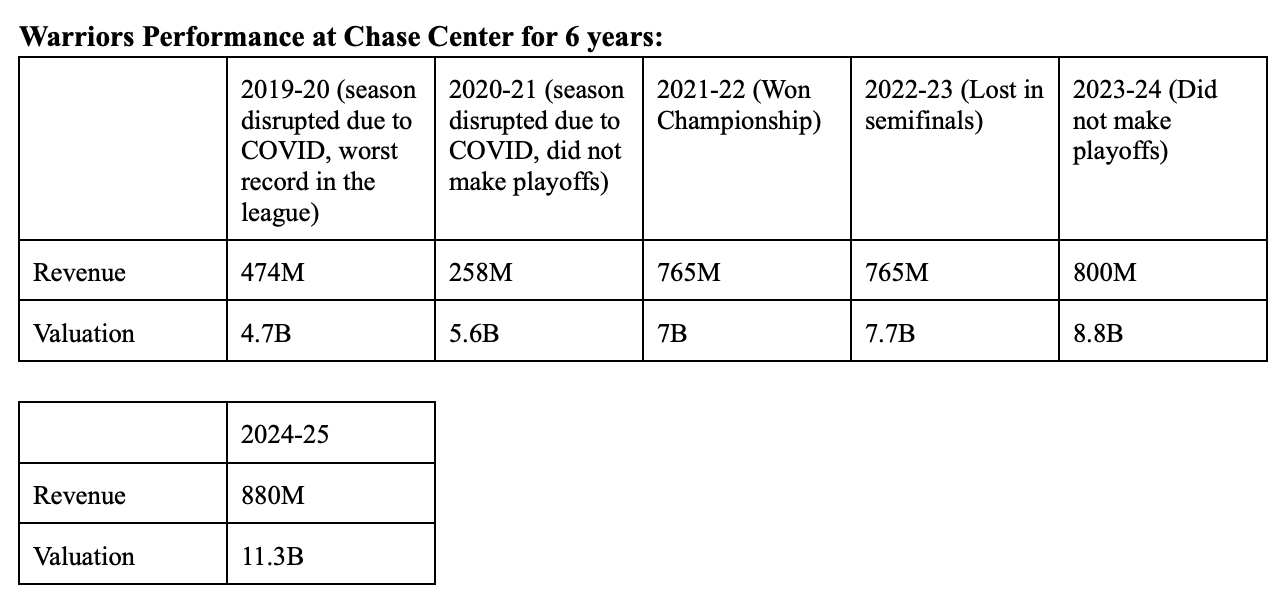
The takeaway from these numbers is simple: despite a 1000-seat decrease in total capacity, both revenue and total franchise valuation rose significantly after the acquisition of Chase Center. This tremendous improvement in financial performance is even more striking given the team’s performance before and after this migration. Prior to the move, the Warriors won three championships in five years with a record of over 70% total games won. The team played far from stellar after the move – in fact, their first season at Chase Center was the worst in franchise history, consisting of 15 wins and 49 losses. In the six years after, the Warriors recorded only one championship. Moreover, the team played double the amount of playoff season games the five years before 2019 as compared to the six years afterwards. All of these statistics lead to the assumption that the Warriors generated more revenue before the transition. The Chase Center then must bear some primary responsibility for the financial success of this franchise in the face of declining on-court performance.
COVID-19 also disrupted the entirety of NBA operations shortly after the move to Chase Center. During the team’s first season at the new arena (2019-2020), the Golden State Warriors were incapable of competing in the NBA bubble and therefore played only 34 home games. In the 2020-21 season, the Golden State Warriors resumed play in a shortened 72-game season, including 36 home games at Chase Center. Fans were still not allowed to attend in person. The only source of revenue that came from NBA games played was broadcasting. And yet, the Warriors continued to dominate financially. This demonstrates that even amid the disruption of COVID-19, the acquisition of Chase Center contributed to a strong financial foundation strong enough for the franchise to outperform many of its pre-COVID years.
What exactly about Chase Center allows the Warriors to boost their revenue and franchise valuation so significantly? One major reason is that the purchasing power in the Bay Area (where Chase Center is) has significantly exceeded that of Oakland (where Oracle Arena was). In 2025, the average household income in Oakland was approximately $97k, compared to $128k in San Francisco. Simply put, this discrepancy allowed ticket revenues to skyrocket for the franchise. At Oracle Arena, the average total cost per home game – accounting for one beer, one hot dog, one ticket, and parking fees – has been $179.93. At Chase Center, the average price of just one ticket has been $285 per game. That represents the highest price among the 30 operating arenas in the region. Overall, the Bay Area has become an economic hub and attracts many tourists.
Second, the acquisition of Chase Center allowed the Warriors' front office to directly own an arena. The franchise did not have such control over Oracle Arena, which was publicly owned by the city of Oakland. Although it cost $1.5 billion to construct the arena, franchise valuation went up by $3.7 billion in 2025 alone due to this new ownership. It allows revenue generation from non-sports operations; for instance, the Warriors partnered with J.P. Morgan Chase to secure a naming-rights deal worth $15 million annually over the next 20 years. The Warriors also host more than 200 private corporate events every year, generating proceeds of up to $160 million.
Third, the Warriors benefited tremendously from their exclusive partnership with Fanatics to operate retail stores in the vicinity of Chase Center. Thrive City, the mixed‑use plaza surrounding Chase Center, includes the 10,000-square-foot Warriors Shop and is part of more than 100,000 square feet of retail and restaurant space. This expanded retail footprint, along with enhanced e‑commerce and a dedicated team store at the venue, provides far greater merchandising revenue potential compared to older venues lacking this scale.
In conclusion, the Golden State Warriors’ move to Chase Center was a strategic financial move, despite the initial $1.5 billion cost and slight reduction in seating capacity. The statistics speak for themselves: franchise revenue and valuation have surged to unprecedented levels and outpace all previous years at Oracle Arena. This has held true even during periods of athletic underperformance and COVID-related disruptions. Perhaps the financial success of this move can serve as a model for how professional sports franchises may benefit from developing and transitioning into modern arenas.